

From 1 to 1 million: what our retirements milestone tells us about CDR demand


Puro.earth recently celebrated a new milestone: 1 million CORCs retired in the Puro Registry. This occasion is a testament to the collective efforts of the entire carbon removal ecosystem: the CDR suppliers bringing high-quality CORCs to market, the buyers and sales channel partners incorporating carbon removal into their climate strategies, the many ecosystem partners helping the industry mature, and the Puro.earth team building the infrastructure that has enabled retirements to scale from 1 to 1 million CORCs in just eight years.
I sit on the Demand and Investor Partnerships team at Puro.earth, meaning I spend my days working with buyers and investors interested in engaging with CDR. Depending on their stage, this work can start quite high level: why is CDR important? What are the different technologies and methodologies available? What even is a CORC?
We work with these partners as their questions move from exploratory to application: how do I structure an offtake? Who has CORC availability? I’m ready to procure, what happens now?
To me, that’s what this milestone represents: exploration to application. This is no longer a theoretical exercise. High-quality CORC supply is coming to market, and with that we see buyers not just buying CORCs but also taking them permanently off the market and claiming the CORC’s full value and attributes toward their climate goals.
I’ll now dive into the details behind this milestone, uncovering the key demand and supply dynamics that brought us this far, and reflecting on what comes next.
Who is Retiring CORCs?
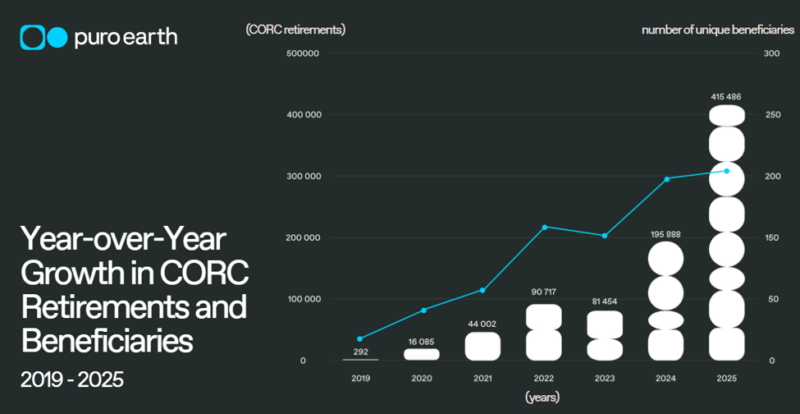
Beneficiaries are the ultimate end-buyers of CORCs and can be defined as the entities that exclusively own the environmental attributes associated with retired CORCs and claim their climate benefits. The market has grown from 43 beneficiaries retiring CORCs through the Puro Registry in 2020, to 204 retiring CORCs in 2025 (4.7x growth), with a total of 650+ unique beneficiaries retiring CORCs over the years.
Scrolling through the beneficiaries on the Puro Registry, we of course see leading buyer names we recognize from offtake announcements and buyer leaderboards: Microsoft, JP Morgan, and BCG, to highlight a few. These corporations have been instrumental in building the industry, demonstrating how CDR should be incorporated into a company’s net-zero strategy and the importance of building capacity now for future CDR supply requirements.
But perhaps even more exciting for me is seeing the names of beneficiaries that I don’t see in industry news every day – GE Aerospace, the State of the Netherlands, the IMF, Delta Airlines, Mercedes-Benz. We see a growing trend of new buyers retiring CORCs from the Puro Registry every year: 2020 saw 42 new end-buyers retiring CORCs; 2025 saw 138. Many of these new buyers prefer to work with market intermediaries, taking advantage of their expertise and existing networks, as opposed to building their own in-house capabilities. While new buyers often begin with smaller purchases, they represent an increasingly diversified demand base and may offer an early indication of who will drive the next million CORCs retired.
The Supply Behind the Demand
Of course, retirements are not possible without the CORCs themselves. Different from offtakes, which represent the forward purchase of CDR credits to be delivered in the future, a retirement can only occur when the carbon removal has occurred, has met Puro.earth’s standard and methodology requirements, and importantly has gone through independent 3rd party verification. The verified CDR is then issued in the Puro Registry, in the form of a CORC, where it is available for retirement.
CORC retirements are therefore intrinsically linked with supply, as evident in the breakdown of retirements by CDR pathway:
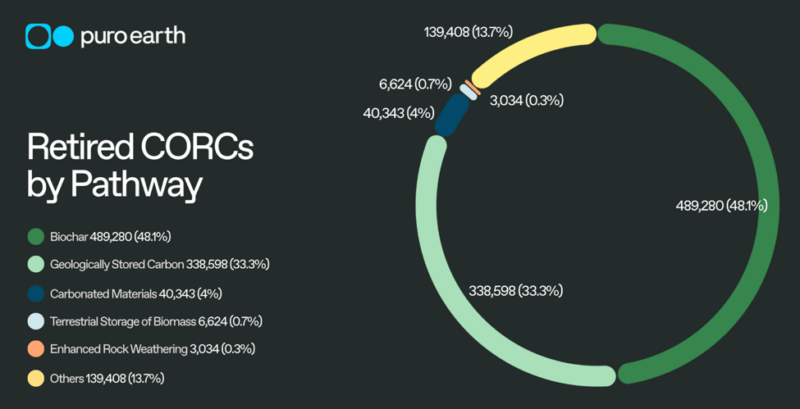
Biochar and Geologically Stored Carbon projects both lead in CORC issuances, accounting for 788,707 CORCs and 584,644 CORCs issued respectively, thus making it no surprise that these pathways also lead in terms of retirements. Even so, we see meaningful activity across all active CDR pathways. Importantly, as more high-quality CDR facilities come online across pathways, the market gains not only additional supply but also greater confidence that carbon removal projects can successfully move from development, to issuance, to sale and retirement.
Underlying Demand Dynamics
Beyond just celebrating the scale of retirements, it’s also important to analyze the underlying demand dynamics of the market. One key metric our team looks at is the time from issuance to retirement, which indicates how long a CORC sits in the registry on average before retirement by the end-buyer. The trend here is fascinating – for CORCs issued in 2020, the average time to retirement is 367 days. In 2025, this dropped to 50 days and so far, for CORCs issued in 2026, this metric is trending at 7 days.
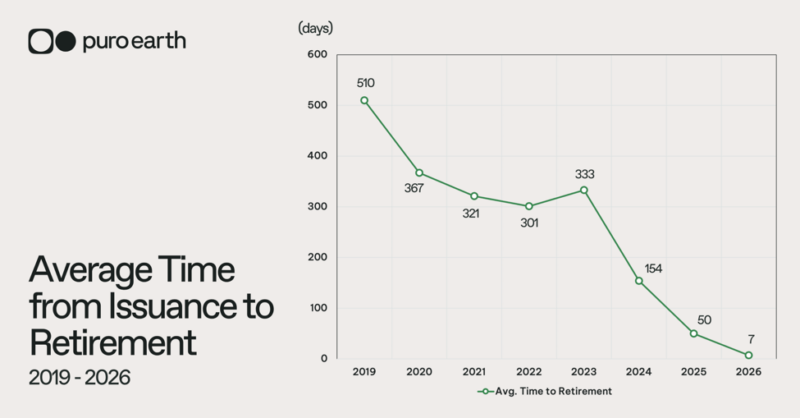
How should we interpret this? To me, this metric helps to evidence the prevalence of offtakes and pre-purchases in the market. Many CDR Suppliers are able to pre-sell their CORCs ahead of issuance, meaning the time to revenue once CORCs are available is quick. This doesn’t necessarily mean that all suppliers have long-term offtakes secured in advance of project operations; buyer interest and pre-purchases can often occur once a facility is operational and getting close-to-issuance, de-risking the purchasing decision for many buyers. Overall, this helps to provide real demand signals in the market, supporting the commercial case for CORCs.
What Comes Next?
The 1 million mark is always a great moment to pause, reflect, and celebrate; but of course, it is a fraction of the gigaton scale industry we strive for when thinking about net-zero at a global level. At Puro.earth, this means continuing to build and scale the critical market infrastructure that brings investment-grade CORCs to market, while ensuring that scientific rigor sits at the heart of our approach.
This starts with the underlying Puro Standard and Methodologies, which provides the scientific rigor that buyers and investors know and trust, and extends to best-in-class certification processes, while supporting CDR suppliers in navigating the certification process as efficiently as possible.
With buyer participation expanding, supply continuing to grow, retirements occurring faster than ever, and the underlying infrastructure in place, I expect the next million CORCs retired to arrive much sooner than the first.
Join our community of climate pioneers
Join our community of climate leaders
Receive updates from Puro.earth, along with CDR market updates and intelligence. By subscribing, you agree to Puro.earth’s privacy policy.