

Two million tonnes removed: what this milestone means for CDR, and what it means for the planet

Puro.earth has now issued more than 2 million CO₂ Removal Certificates. Jan-Willem Bode, President of Puro.earth, reflects on what the milestone means for Puro.earth, for the carbon removal sector and for the climate.
This month, Puro.earth issued its two millionth CO₂ Removal Certificate (CORC). Each one represents a tonne of carbon dioxide removed from the atmosphere, independently verified, and durably stored. They account for 2 million tonnes of carbon removal that has already happened – measured, audited and recorded in the Puro Registry. A huge thanks to everyone who has worked with us to get here – none of this happens without you and your support – and it’s an important milestone not just for us, but for the CDR sector as a whole.
When we reached our first million in March 2025, I said it was just the beginning. Around 19 months on, it is worth looking at what has changed – because the second million looks quite different from the first.
A look at the numbers
It took around five years to issue our first 500,000 CORCs. The second million has been issued in around 19 months – less than a third of the time it took to issue the first. We now issue an average of more than 50,000 CORCs a month.
The composition of that second million matters more than its timing. Every one of those CORCs was issued under a methodology requiring storage of at least 100 years. And a growing share now comes from industrial-scale facilities issuing on regular cycles, rather than from one-off pilots. Today, we have certified more than 100 suppliers across eight methodologies, with a further 26 in the pipeline, with an audit booked. Many of these issue on a monthly or even a weekly cycle.
Reaching this volume without compromising rigour has meant rethinking how certification works. Over the past two years we have invested in the people, processes and digital infrastructure to bring it into a data-driven era: MyPuro 2.0 for managing certification and issuance in one place; the Puro dMRV Connect API, replacing spreadsheet-based reporting with structured data flows from suppliers’ operations; the Audit Booking Calendar; Puro Issuance Plus to support higher-frequency issuance at industrial scale; and Preliminary Assessments that de-risk projects before formal audit. Over this year, we have cut the median time to issuance by 25%.
What has not changed is the foundation on which we operate. Every CORC is still issued only after an independent third-party audit against a published methodology, approved by our independent Advisory Board of scientists. Our programme-level CCP eligibility from the Integrity Council for the Voluntary Carbon Market (ICVCM) recognises that governance framework, and we continue to review and update our methodologies as the science advances.
What it means for the carbon removal sector
Most importantly, carbon removal now has a track record. Suppliers that have regularly issued credits can show buyers and lenders a delivery history, not just a projection. That is what allows buyers to commit to larger, longer-term offtakes, and what allows investors to underwrite new capacity with confidence.
I’ve spoken at length over the past 12 months about how we are already seeing the market adopt the structures that follow – offtake-backed borrowing, floor-price mechanisms and forward credit streams – which lower the cost of capital for the next wave of projects.
Demand is broadening too. More than 1 million CORCs have now been retired in the Puro Registry, which has been used by more than 900 buyer organisations to date. The number of companies retiring CORCs each year has grown 20-fold since 2020, and over half of those retiring in 2026 are first-time buyers. In 2019, a CORC took an average of 510 days to go from issuance to retirement; so far in 2026, that figure is 19 days.
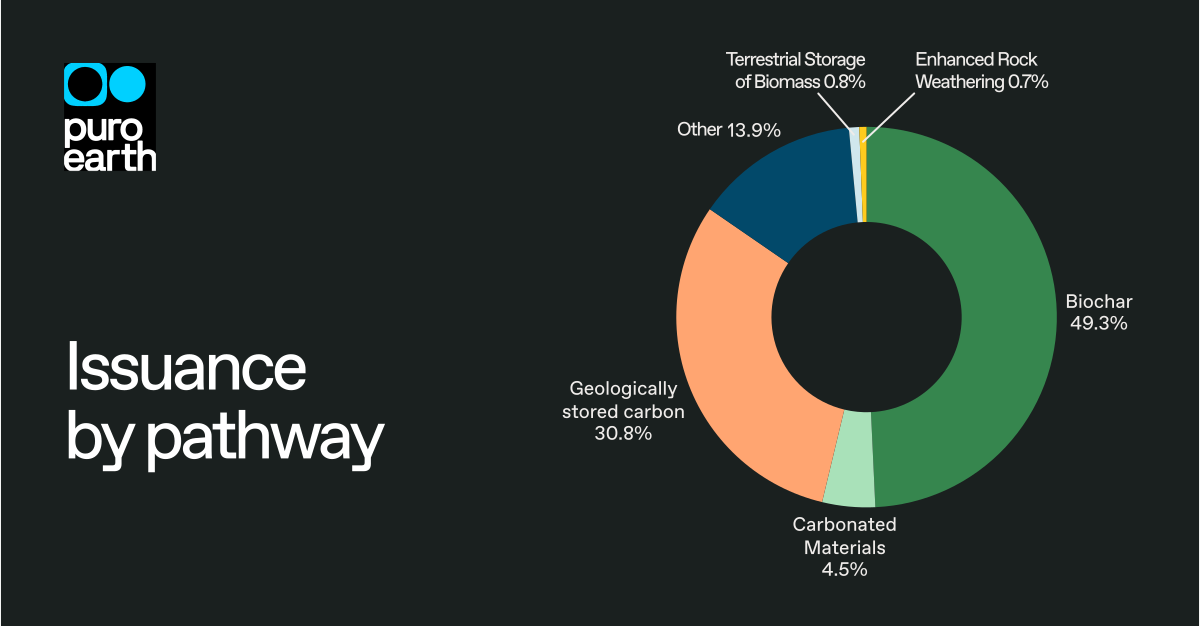
This is also a multi-pathway market. Of the 2 million CORCs issued, 49% came from biochar, 31% from geologically stored carbon – including bioenergy with carbon capture and storage (BECCS) and direct air carbon capture and storage (DACCS) – 4% from carbonated materials, 0.8% from terrestrial storage of biomass and 0.6% from enhanced rock weathering. No single technology will deliver the volumes the climate requires, and a credible market needs room for proven and emerging pathways alike.
Policy is starting to reinforce this. The EU’s Carbon Removals and Carbon Farming (CRCF) certification framework, the ongoing review of the EU ETS – including the potential integration of permanent removals – and national procurement programmes in countries such as Canada, Norway, Denmark and Sweden are beginning to build removals into compliance and public-sector frameworks. That gives suppliers and buyers greater certainty about the role of carbon removal beyond 2030.
What it means for the planet
Two million tonnes is equivalent to around 7% of the annual CO₂ emissions of a small European country of between 5 and 6 million people. It is carbon that has been taken out of the atmosphere and stored for at least 100 years, and in many cases far longer.
We should also be clear about scale. IPCC scenarios suggest the world will need to remove between 6 and 16 billion tonnes of CO₂ a year by 2050 to limit warming to 2°C. Two million tonnes is a small fraction of one percent of a single year of that need.
That comparison carries two important lessons. First, carbon removal complements deep emission reductions; it does not replace them. Its role is to address the residual emissions that sectors such as aviation, cement, steel and shipping cannot yet eliminate, and to begin drawing down historic emissions. Second, the path from millions to billions of tonnes will not be a single leap. It will be built tonne by verified tonne, on the standards, data and trust that allow capital to flow at scale. Getting that infrastructure right at 2 million tonnes is what makes billions possible.
Looking ahead
No registry reaches a milestone like this on its own. Thank you to our suppliers, who build the facilities, take on first-of-a-kind risk and open their operations to independent scrutiny. To our buyers – the early movers who committed when the market was unproven, and the new entrants joining every month. To the auditors, the scientists on our Advisory Board, and the partners and investors who have backed durable carbon removal as an essential climate solution. And to the Puro.earth team, who have rebuilt how CDR certification works while issuing at the highest volumes in our history.
We are on track to issue more than 1 million CORCs in 2026 alone, and expect to issue close to 2 million in 2027. Our focus now is on making certification more predictable and more transparent for every participant, without ever making it less rigorous.
The next phase brings new opportunities. Governments are building removals into targets, compliance markets and public procurement. The Science Based Targets initiative’s (SBTi) new Corporate Net-Zero Standard recognises companies that address ongoing emissions from 2027, and requires large companies to buy removals from 2035. This is positive progress since the first 1 million milestone last year.
What’s also new is how companies are using CDR not just to claim the carbon removal benefit, but for use within their own value chains to create low-carbon industries. There is a wide range of potential use cases, ranging from storing CO₂ in the concrete they use, locking it away through biochar made from agricultural crop residues, or using rock weathering on the fields that grow their ingredients.
However the market evolves, we’ll be there to support it. The first million CORC issuance showed that durable carbon removal could be measured, verified and traded with integrity. The second shows it can be done at industrial scale. The task now is to do this again and again, and build on this momentum.
” The first million CORC issuance showed that durable carbon removal could be measured, verified and traded with integrity. The second shows it can be done at industrial scale. “
Join our community of climate pioneers
Join our community of climate leaders
Receive updates from Puro.earth, along with CDR market updates and intelligence. By subscribing, you agree to Puro.earth’s privacy policy.